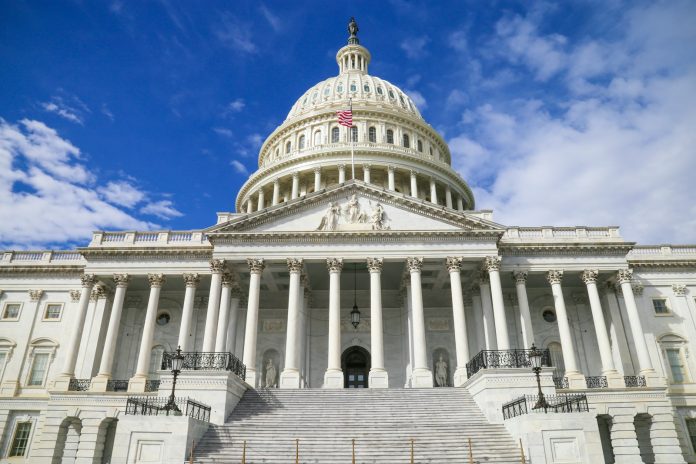
WASHINGTON — A U.S. House of Representatives subcommittee voted Thursday to amend the SCREEN Act, a proposed measure that would establish nationwide, site-based age verification requirements for users attempting to access adult content online. Following the vote, the panel advanced the bill to the full House Committee on Energy and Commerce for further consideration.
The action comes as lawmakers continue to push a broader package of online safety proposals. As previously reported, the House Subcommittee on Commerce, Manufacturing, and Trade has spent recent months working to advance several bills aimed at limiting minors’ exposure to online material deemed harmful, with the Shielding Children’s Retinas from Egregious Exposure on the Net (SCREEN) Act serving as a central piece of that effort.
When Republican Sen. Mike Lee of Utah and Rep. Mary Miller of Illinois introduced the SCREEN Act earlier this year, the legislation included enforcement provisions tied directly to the Federal Trade Commission Act. Under the proposal, any violation of the SCREEN Act would be treated as an unfair or deceptive act or practice, exposing violators to civil penalties of up to $10,000 per violation.
During Thursday’s hearing, Rep. Craig Goldman of Texas presented an amended version of the bill to the subcommittee. Goldman told lawmakers that his revisions draw inspiration from Texas’ own age verification statute, House Bill 1181, which became the subject of the landmark Supreme Court case Free Speech Coalition v. Paxton.
According to Goldman, the updated version of the SCREEN Act aligns federal policy with what he described as a proven state-level framework. He argued that the changes would apply similar protections nationwide, rather than limiting them to individual states. Goldman said children should receive the same level of online protection regardless of where they live and emphasized the need for a consistent national standard.
Goldman added that courts have already upheld protections for minors under Texas law and suggested that Congress should build on that legal foundation. He said modernizing the SCREEN Act would strengthen efforts to shield children from harmful online content while creating a clearer and more uniform regulatory environment.
Despite Goldman’s comments, some observers noted that the amended bill does not directly mirror the Texas statute. Industry attorney Lawrence Walters pointed out that the revised SCREEN Act differs in structure and scope and could have significant legal consequences for existing state laws.
Walters explained that federal law typically takes precedence over state law, and the amended SCREEN Act explicitly reinforces that principle. The bill includes language stating that no state or local government may enforce any law or regulation related to age verification if it conflicts with the federal standard established by the act.
That preemption clause has major implications, as roughly half of U.S. states have already enacted their own age verification laws. If the SCREEN Act becomes federal law, its provisions would override those state statutes and replace them with a single national framework.
Following debate, the subcommittee approved Goldman’s amendment by a voice vote. With that step completed, the revised SCREEN Act now moves forward to the full Committee on Energy and Commerce, where lawmakers will review the bill and decide whether to advance it further in the legislative process.
The vote marks a key development in the ongoing national debate over age verification, online safety, and the balance between federal authority and state-level regulation.